Translated from the original Spanish article. Read in Spanish
Before the little colored bricks, LEGO made wooden ladders… and ironing boards. The story of the world's most famous toy begins in a carpentry workshop that was about to go bust.
A carpenter with no customers
Billund, Denmark, 1932. The carpenter Ole Kirk Christiansen is going through a terrible time: it's the Great Depression, almost nobody has money and his workshop runs out of customers.
To survive, he makes ladders, ironing boards and small wooden objects. He builds miniature ladders as samples to sell the big ones… and discovers something better: toys.
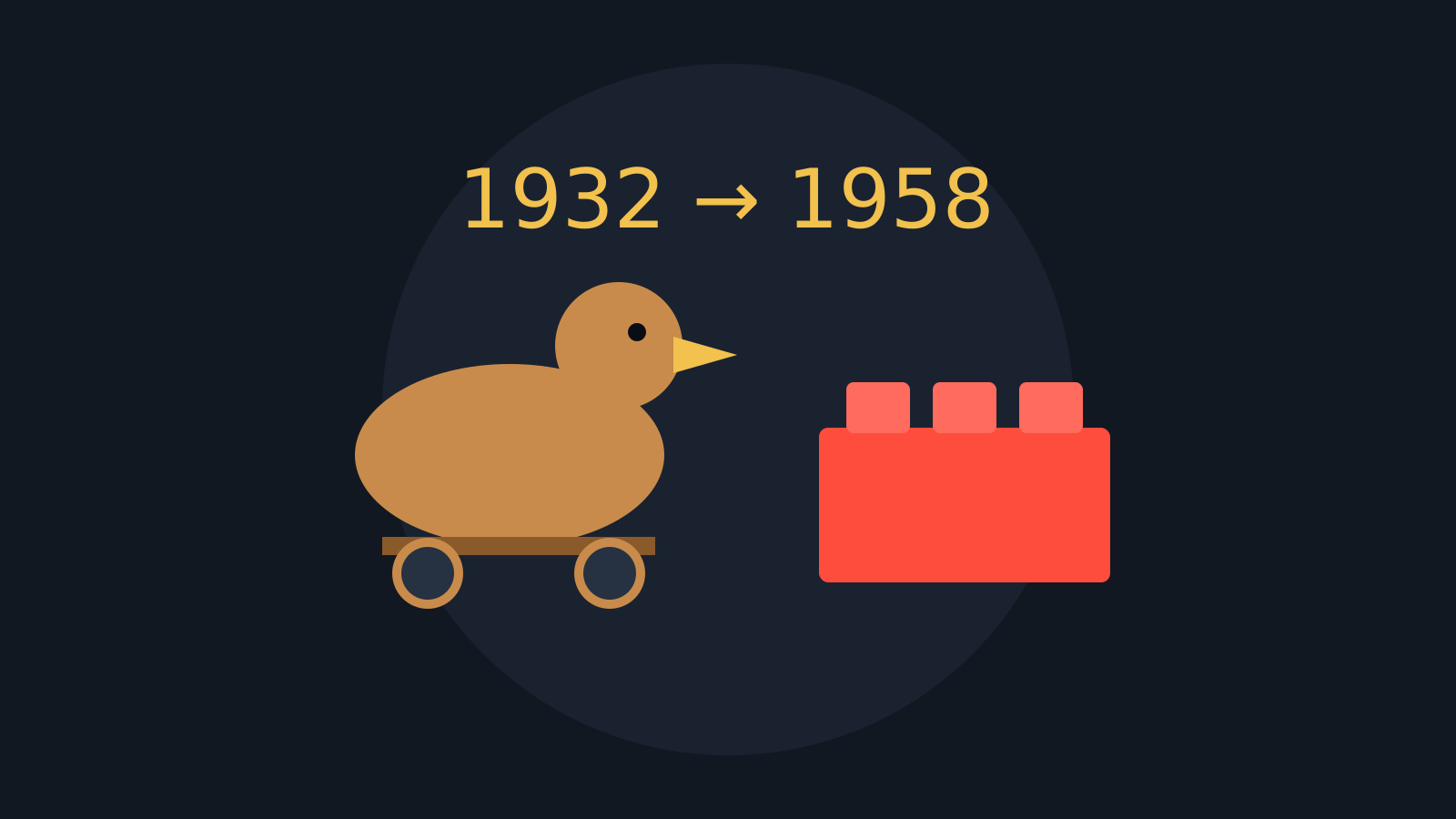
He starts making wooden ducks on wheels, trucks and yo-yos. Many were pull toys, the kind children drag along on a string.
"Play well"
Ole looks for a name for his business and holds a small contest… which he wins himself. He picks two Danish words: leg godt, meaning "play well". He joins the two words… and LEGO is born.
LEGO comes from "leg godt": "play well" in Danish.
His son, Godtfred Kirk Christiansen, started very young in the workshop: at around 17 he was already designing models for the company.
Fire and plastic
In 1942, a fire destroys the factory. Ole rebuilds it.
After the war, he makes a very risky decision: in 1947 he buys Denmark's first plastic injection-molding machine. Many people thought plastic toys would never replace wooden ones.
The family was inspired by interlocking plastic bricks designed by the Briton Hilary Fisher Page. And in 1949, LEGO began making its own bricks, which it called "Automatic Binding Bricks".
The perfect brick
Those first bricks had a problem: they didn't hold together well, and models fell apart easily.
The solution came in 1958, when LEGO patented the brick with tubes inside. Thanks to those tubes, the pieces click firmly and don't come loose, yet they can be pulled apart effortlessly. It's the same system the pieces still use today, which is why a brick from the 1960s still fits one made today.
A 1958 LEGO brick still fits one made today.
A lesson in building
LEGO's story is that of a family that didn't give up: not during the crisis, not after the fire, not when everyone doubted plastic. Every problem forced it to reinvent itself.
From ironing boards… to the most famous toy in the world.
This story is also a video
We tell it in a short video on our channel (in Spanish). Subscribe: there's a new story every week.
Watch the video on YouTubeWhat other brand started with something you'd never imagine?
Tell us in the comments on the video.
Sources (in Spanish)
- Historia de la empresa y origen del nombre: Wikipedia, Lego, y Wikipedia, «Timeline of Lego».
- Biografía del fundador: Wikipedia, Ole Kirk Christiansen.
- Historia oficial (de 1932 a hoy): The LEGO Group History.
Photos are from Wikimedia Commons under free licenses; the author and license are shown under each image. Illustrations are our own. We don't use brand logos.