The 1960 study that set a date for the end of the world: Friday, November 13, 2026
It didn't come from a cult: it was published in the journal Science. A physicist calculated that on that day the planet's population would become infinite. And his curve was right for thirty years.
Translated from the original Spanish article. Read in Spanish
A scientific study set a date for the end of the world: Friday, November 13, 2026. And it didn't come from a cult or a prophecy: it was published in one of the world's most prestigious scientific journals, Science, on November 4, 1960.
The study
Its title was, literally, "Doomsday: Friday, 13 November, A.D. 2026".
It was written by Heinz von Foerster, an Austrian-American physicist and one of the pioneers of cybernetics, together with two colleagues from the University of Illinois: Patricia Mora and Lawrence Amiot.
The curve that went crazy
The authors gathered twenty-four estimates of world population, from the year 1 AD to 1958. And they found something unsettling: the population wasn't just growing, it was growing faster and faster.
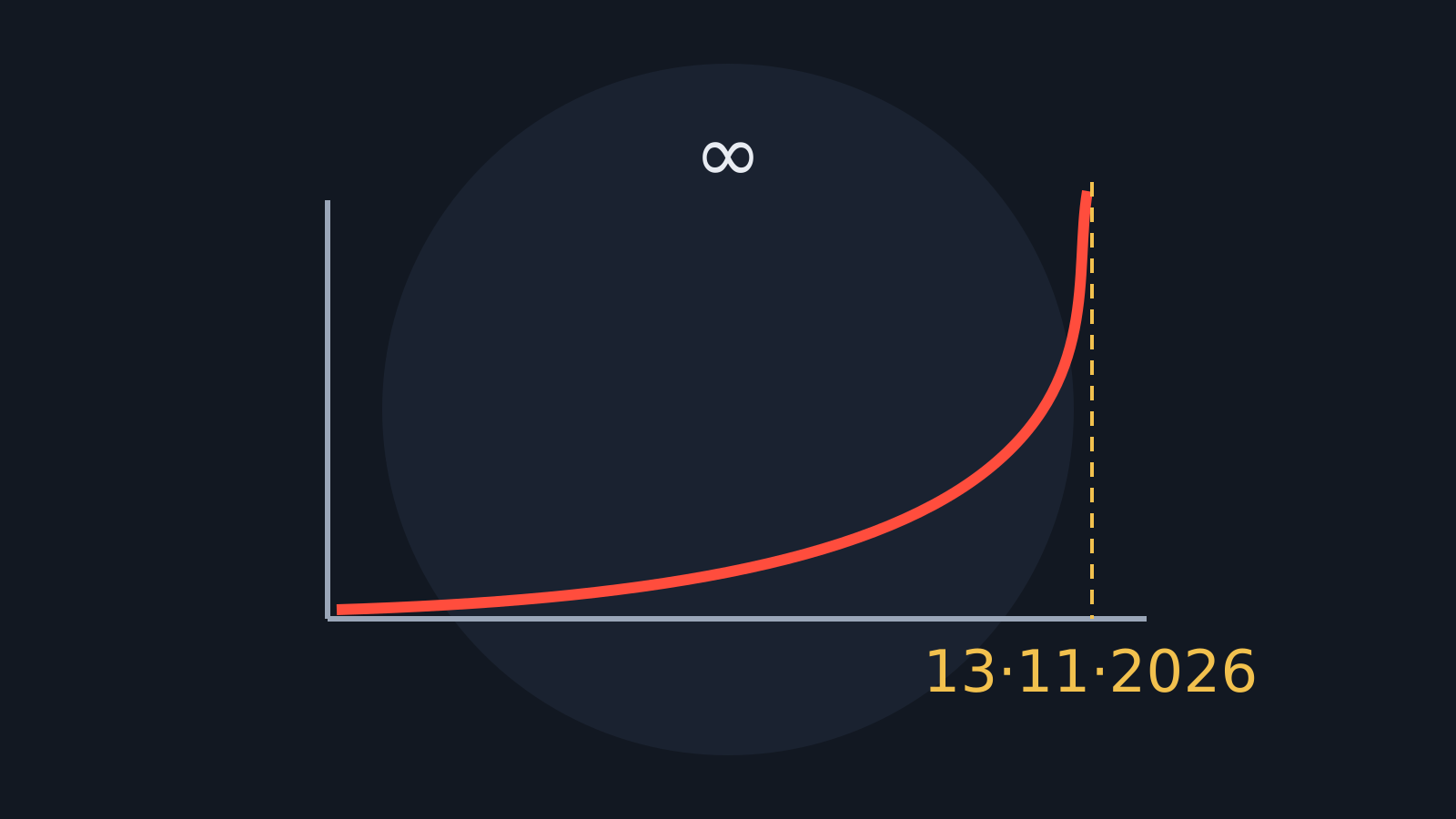
It wasn't normal growth, not even "exponential" growth, like interest in a bank account. It was an even more extreme curve, called hyperbolic: the more people there were, the faster it grew.
According to their formula, the curve reached infinity on a specific date: the year 2026.87. Translated to the calendar, that fell right in November 2026.
The formula gave the year "2026.87": November 2026.
"Squeezed to death"
The authors' conclusion, half serious and half joking, was striking: our great-great-grandchildren wouldn't starve to death… they would be squeezed to death.
Of course, nobody really believed we would become infinite. The idea was to warn that this rate of growth couldn't last forever.
Why a Friday the 13th?
Here's the touch of humor: November 13 was Heinz von Foerster's birthday. And the fact that it fell on a Friday the 13th gave it the perfect ominous touch.
November 13 was Heinz von Foerster's birthday.
Was he wrong?
Many called it absurd… but the surprising part is that his curve was right for about thirty years. World population followed that line almost to the letter.
Until, in the early 1990s, reality fell behind: in many countries fewer babies started being born. The curve flattened out, and the "explosion" never came.
How many of us are there today?
Today there are about 8.3 billion of us, and we're growing more and more slowly. According to United Nations projections, world population would peak at around 10 billion in the 2080s, and then start to decline gradually.
So no: nobody will be squeezed to death on November 13. But the question von Foerster asked is still alive: how many people can live well on this planet?
This story is also a video
We tell it in a short video on our channel (in Spanish). Subscribe: there's a new story every week.
Watch the video on YouTubeDo you think one day there will be too many of us for this planet?
Tell us in the comments on the video.
Sources (in Spanish)
- Heinz von Foerster, Patricia M. Mora y Lawrence W. Amiot, «Doomsday: Friday, 13 November, A.D. 2026», revista Science, vol. 132 (4 de noviembre de 1960).
- Historia del estudio y por qué falló: Popular Science y Futura Sciences.
- Población mundial actual y proyecciones: Naciones Unidas, World Population Prospects.
- Biografía de Heinz von Foerster: Wikipedia, Heinz von Foerster.
Photos are from Wikimedia Commons under free licenses; the author and license are shown under each image. Illustrations are our own. We don't use brand logos.